Partner and Projects
Partner
University of Applied Science Munich - Laboratory for Geodetic Surveying
Collaboration on the three-dimensional mapping and documentation of cavities and ice fields in alpine environments
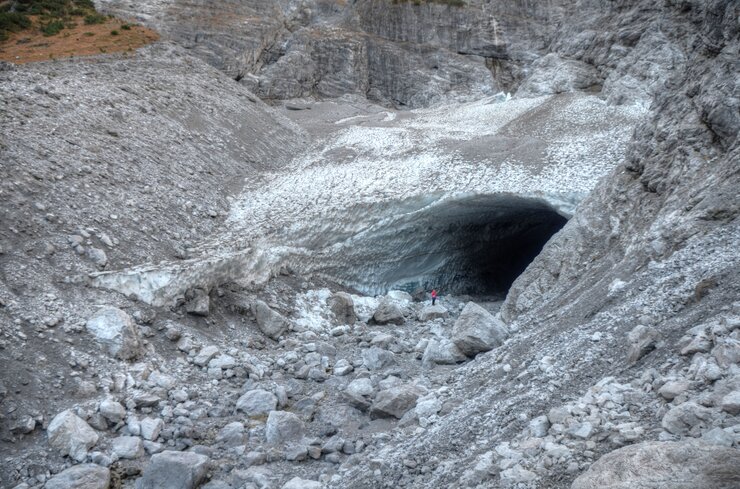
Eiskapelle - 3D survey of the Firneis Glacier in the Nationalpark Berchtesgaden, Germany
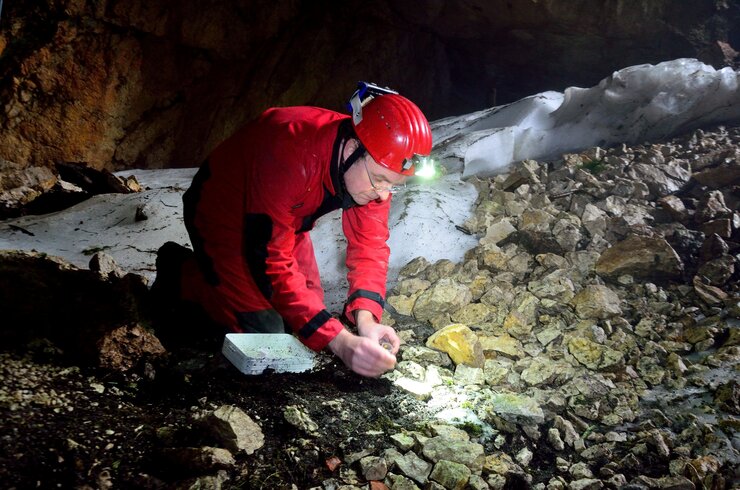
At the foot of the Watzmann’s east face in Berchtesgaden National Park lay Bavaria’s 100th most beautiful geotope—the Eiskapelle. Avalanche snow from the east face fed this lowest-lying permanent firn ice deposit in the Bavarian Alps. Meltwater seeped into the ice mass, forming an active cave system. Depending on precipitation and the season, the shape of the ice surfaces changed constantly. Since 1994, the cave system has been surveyed every year in late fall by speleologists. By 2025, the ice field had completely melted.
In collaboration with the Institute for Applied Karst and Cave Science, the Technical University of Munich, and Munich University of Applied Sciences, six surveying campaigns have been conducted to date for the three-dimensional mapping of the ice mass.
Nationalpark Berchtesgaden Magazine:
Eisige Schönheit -Vertikale Wildnis 32, 2018
Schwindende Schönheit - Vertikale Wildnis 45, 2024
Pressemeldung Nationalpark Bgd zum Einsturz der Eiskapelle 09.09.25
Environmental Impact Assessment of a Show Cave in Georgia
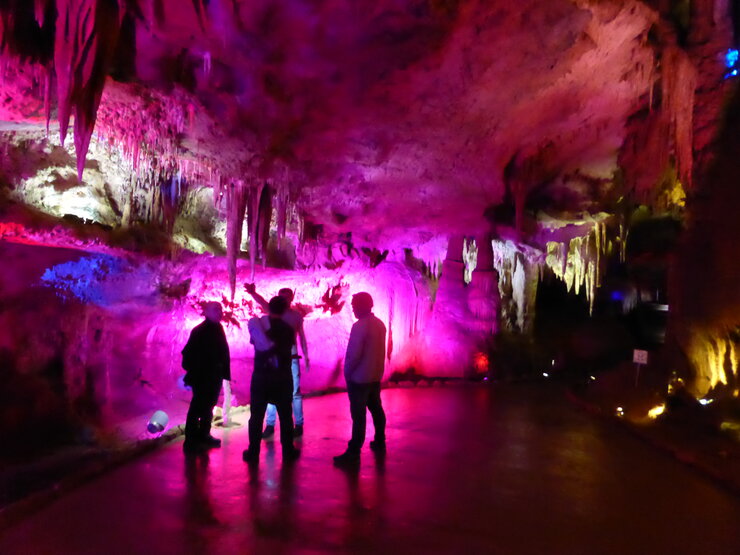
In 2017, an environmental impact assessment for a tourist cave was prepared for the German Federal Ministry for Economic Cooperation and Development (BMZ) as part of the support program for protected areas in the Caucasus—Georgia.
Based on previously reported negative environmental impacts of visitors on the cave’s ecosystem, including the lampion flora, the environmental risks associated with operating the tourist cave were assessed on-site in Georgia.
To this end, topics such as the lighting system, biodiversity, cave climate, geology and hydrology, visitor paths, and tourism were examined, and recommendations for improved environmental management were developed.
Life in the Dark – Cave Animals in the Bavarian Alps
Funded by the Bavarian State Ministry of the Environment and Consumer Protection, eight caves in the Bavarian Alps were studied from a zoological perspective between 2015 and 2016. The sites were visited multiple times to obtain a year-round picture. Six caves are located in FFH areas, three in nature reserves, and two had no protected status; one of these is a tourist cave.
These include the Gamsbockloch in the Oberallgäu, the Angerlloch near Garmisch-Partenkirchen, the Wendelsteinhöhle, the Große and Kleine Spielberghöhle near Rosenheim, the Schwarzbachloch, and the Schuster- and Schneiderloch in the Berchtesgadener Land. A total of 231 different animal species were found, including rare species and first records.
The final report was presented by Ulrike Scharf, Bavarian Minister of State for the Environment and Consumer Protection, at the Wendelstein.